Lecture 6: Stochastic Approximation and Stochastic Gradient Descent
强化学习中的数学原理 | 第六课

这一课主要是为之后的课程补齐一个知识鸿沟,不然后面学temporal-difference learning会觉得那个算法很奇怪
同时随机梯度下降这个方法在之后也有广泛的应用
Revisit the mean estimation problem
知道一个随机变量
为什么我们要关心 mean estimation 这个问题?因为 RL 中 state/action value 经常就用 mean 来估计
New question: how to calculate the mean
我们并不是指
In particular, suppose
and hence
then,
Furthermore, consider an algorithm with a more general expression:
这种算法实际可以看做一种 special 的 SA algorithm,也可以看做一种 special 的 stochastic gradient descent algorithm,等之后学了就知道了
Stochastic approximation (SA 随机近似):
- SA 指一类涉及随机迭代的算法,用于求解方程或者优化问题
- 同样能求解方程的方法还有梯度下降/上升…SA相比之下的优势是不需要知道求解的方程的表达式、导数、、、
Robbins-Monro (RM) algorithm:
- 是 SA 领域的一个具有开创性的工作
- 我们常用的 stochastic gradient descent 随机梯度下降方法是 RM algorithm 的一种特殊形式
- 开头讲的 mean estimation 问题也是 RM 算法的一种特殊形式
Suppose we would like to fiind the root of the equation
where
- 求解一个函数为0的根是一个应用广泛的问题,例如求解极值时就要求出导数为0的解
所以我们该怎么求解
- 知道表达式的情况
- 不知道表达式的情况,例如一个神经网络,我要求解输入什么样的
能得到一个0的输出呢
The RM algorithm can solve the problem:
where
is the kth estimmate of the root is the kth noisy observation is a positive coefficient
The function
- Input sequence:
- Noisy output sequence:
哲学的思想:模型和数据至少要有一个,这里就是没有模型,但有数据
接下来我们要分析为什么 RM 算法能收敛
Intuition:
不是严谨证明
要求是单调增的函数
- when
, we have . Then,
- when
, 同理
我们也发现,这个算法要求条件很强,一定要是递增的函数
补上一个算期望的例子,使用RM算法
- Consider a function:
我们只要解出
我们不知道
进一步又有:
求解RM算法是:
Suppose we aim to solve the following optimization problem:
is the parameter to be optimized is a 随机变量, and 可以是标量或矢量, 是标量
Method 1: gradient descent (GD)
Drawback 缺点:期望的求和很难拿到,我们没有模型,只有数据,所以接下来我们看只有数据的时候用什么方法来求
Method 2: batch gradient descent (BGD)
Drawback: 每次更新
Method 3: stochastic gradient descent (SGD)
- Compared to GD method: Replace the true gradient
by the stochastic gradient. - Compared to the batch gradient descent method: let
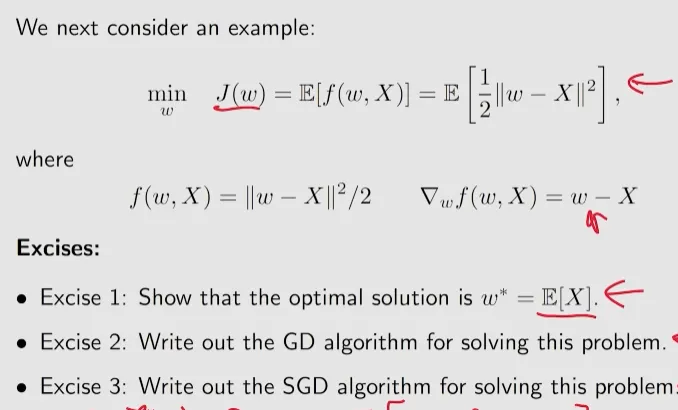
Answer:
- Exercise 1: 略
- Exercise 2: 写出 GD 算法来解决这个问题
- Exercise 3: 写 SGD 算法
- Note
- 这和 mean estimation algorithm 的公式一样
- 意味着 mean estimation algorithm 是SGD的一种特殊情况
其实我们还没证明 SGD 这样不使用期望而直接使用一个
证明思路就是证明 SGD 是一种特殊的 RM 算法
SGD’s aim is to minimize
Then the RM algorithm for solving
这正是 SGD 的公式,因此证明了SGD就是一种特殊的RM
刚才分析了收敛的正确性,现在我们要分析一下收敛时的一些有趣的行为
Question: SGD 使用随机的一个梯度来代替了GD里的期望,这是否会导致SGD在收敛的时候随机性较大?
结论是当
大致是通过比较相对误差,具体过程省略了
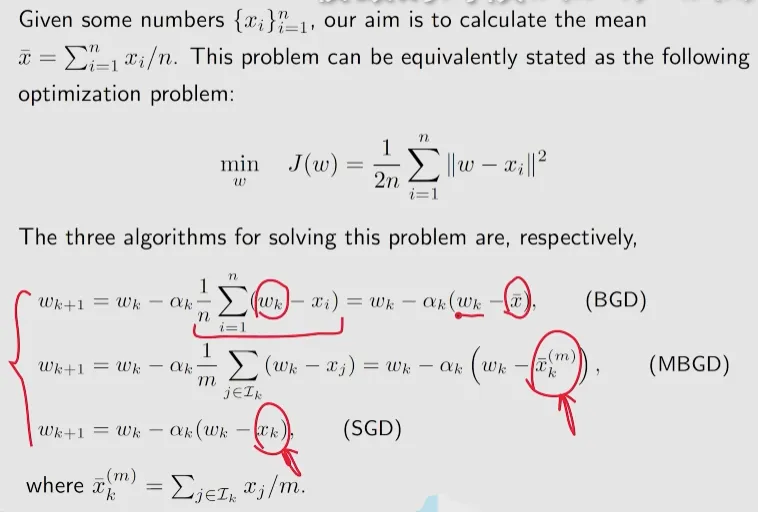
这里讨论了SGD中不存在随机变量,而是确定的一组值时的形式,我对这一点感触不深,甚至感觉有点显然,可以等之后遇到了实际问题再来回顾
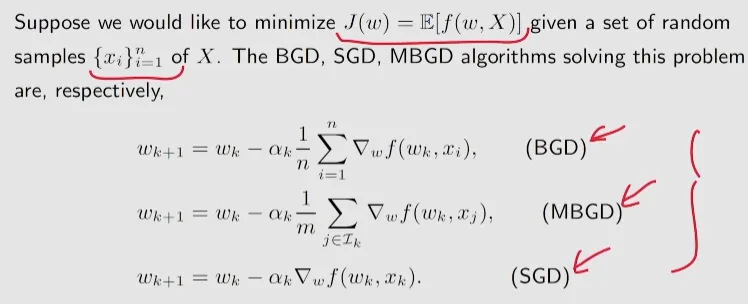
- BGD 每次要用到所有的采样,这是符合最真实的
- MBGD 就采样 m 个
- SGD 采样 1 个
Compare MBGD with BGD and SGD:
- MBGD 相比 SGD 肯定随机性会下降
- MBGD 相比 BGD 不需要那么多样本,更加灵活高效
- MBGD 的 m = n 时,也不完全等于 BGD,因为BGD选取的n个样本是全部样本,不重复,但MBGD是随机采样n次,可能重复