Lecture 2: Bellman Equation
强化学习中的数学原理 | 第二课

Why return is important?
return 是我们评估 policy 好不好的手段
discount rate 是全程记录的,我之前误以为是只有停留在原地才会有discount rate
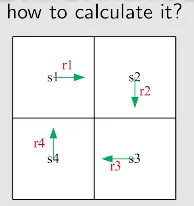
Bootstrapping! 左脚踩右脚上天
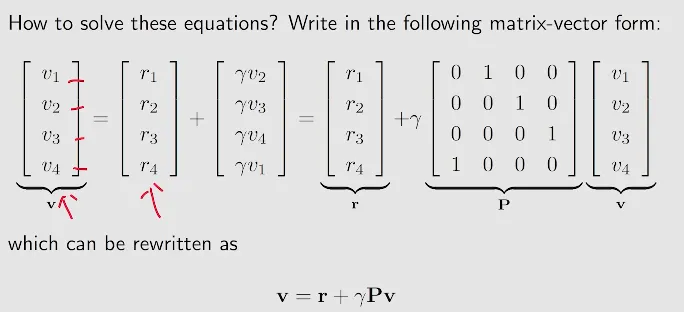
求解这个矩阵方程就能算出
这就是贝尔曼公式(只针对这个特殊例子)
核心思想:一个 state 的 value 来自别的 state 的 value
: the reward obtained after taking
都是随机变量 即都可以求期望…
The step is governed bythe following probability distributions:
is governed by is governed by is governed by
接下来可以推广到多步的 trajectory
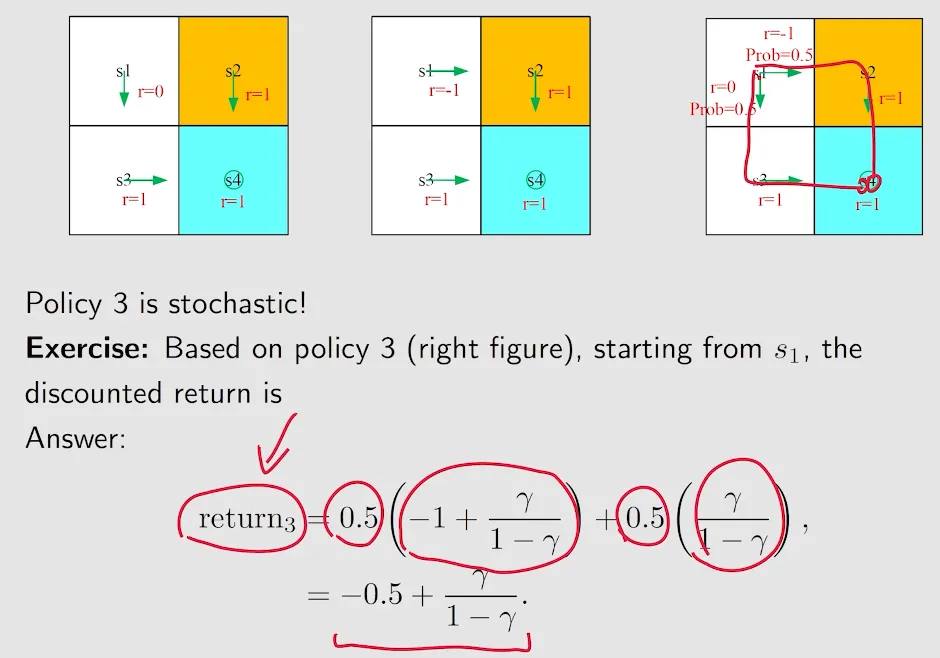
the discounted return is
也是随机变量,因为 也都是随机变量 再重复一遍,
也是随机变量,同样的 也会有不同的
就是
Remarks:
- 是
的函数,不同 触发得到的 state value 不同 - 是 policy 的函数,不同策略得到不同 state value,这也是写成
的原因,其实就是 的意思 - 代表了状态的价值,state value 越大,指能得到更多的return,policy 更好
Q: What is the relationship between return and state value?
return 是实际的结果,state value 是估计的结果(估计的来源是policy中某几步的概率)
return 是一条结果,state value 对应的是全期望公式
开始推导,there is some math.
Consider a random trajectory:
The return
then, 根据 state value 定义:
Next, calculate the two terms, respectively.
First, calculate the first term
Note that
- This is the mean of immediate rewards
Second, calculate the second term
Note that:
即马尔科夫无记忆性,知道了 就不必要知道 了 倒数两行求和能换序,只要求和是收敛的都能换序
This is the mean of future rewards
Therefore, we have
Highlights:
- 这就是tmd贝尔曼公式,描述了不同状态的 state value 之间的关系
- 包含两项:第一项 immediate reward term,第二项 future reward term
- 这个式子不是一个单独的式子,而是对所有的状态都成立,有 n 个状态就有 n 个这种式子
and are state values to be calculated. Bootstrapping!
is a given policy. Solving the equation is called policy evaluation. Evaluate 这个 policy 是好是坏
and represent the dynamic model. What if the model is known or unknown? 未来再搞
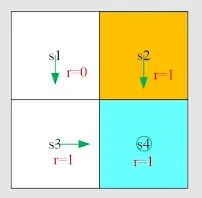
让我们把这个例子里的所有 Bellman equation 写出来
First,consider the state value of
and 就是在 状态只有 这个策略, 就是 , 表示概率! and and
【强化学习的数学原理】课程:从零开始到透彻理解(完结)】 【精准空降到 11】
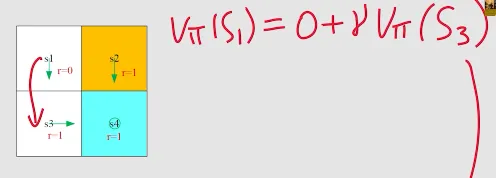
把握好 immediate reward + future reward 的含义
- immediate reward 就是在这个状态下采取某一个 action 时得到的单个 reward
- future reward 是执行完这个 action 后的状态
的state value - 上述操作遍历所有 action,注意用
加权平均
从而得到方程组:
解得:
把
那算出来了以后干什么呢?后面再讲(improve policy)
再看一个例子
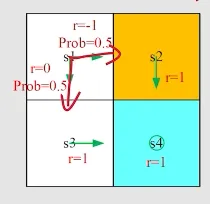
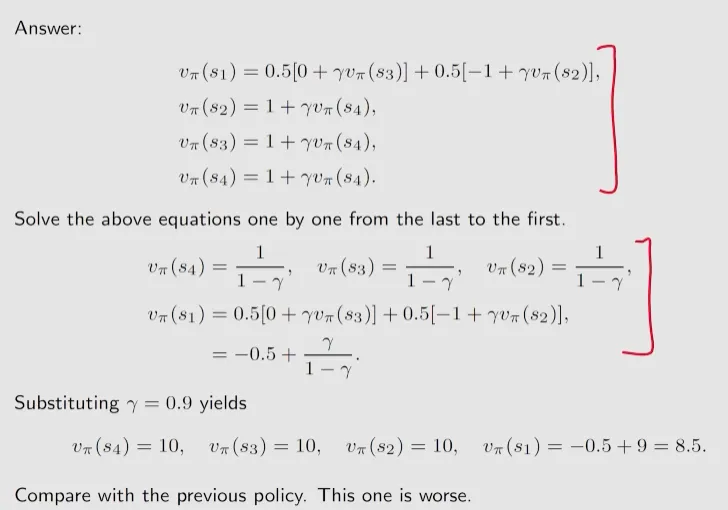
可以类似的把公式手写出来
回顾一下Bellman Equation
- 可以发现LHS有一个state value,RHS有另一个state value,所以单从这一个公式,两个未知数,我们要求出state value是不可能的。
- 但是上面这个式子(我们可以称之为elementwise form逐元素形式)is valid for every state
,这意味着有 个像这样的等式 - 把这几个等式合起来,就得到一系列线性方程,这可以整理成 matrix-vector form
Recall that:
通过乘法分配律,前一项直接记作
- 处于状态
,按照 选择action,得到的即时奖励的期望
后一项,未来价值部分:
先对
为了把所有
然后就能得到matrix-vector form:
where:
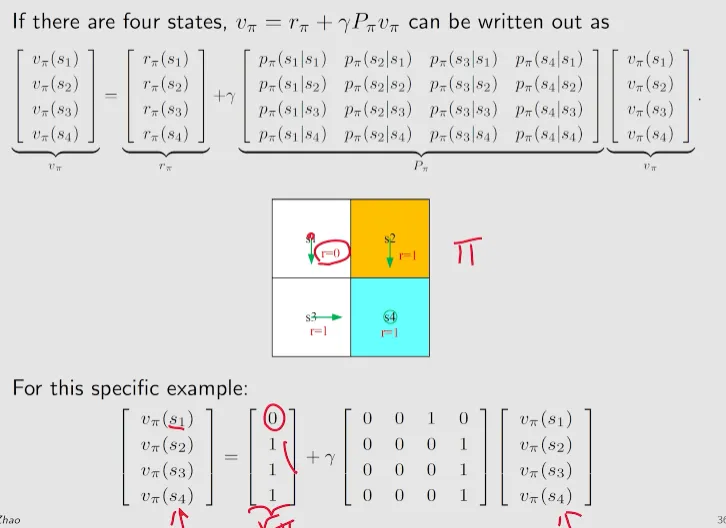
为什么我们要求解state value?
给定一个policy,解出他的state value,这样的过程,我们称为policy evaluation
it’s a fundamental problem in RL, it’s the foundation to find a better policy
刚才推导的 Bellman equation in matrix-vector form
The closed-form solution 解析解形式:
- 涉及到矩阵求逆(这个矩阵是可逆的,证明暂时省略,大致是特征值都>0),要用数学工具,所以我们一般不使用这个方法,使用下面这种迭代的方法
An iterative solution 一种迭代方法:
当
非常重要,我们前面理解过state value后,再理解action value就会容易多
- State value: the average return the agent can get starting from a state
- Action value: the average return the agent can get starting from a state and taking an action
我们为什么要关注 acton value?因为我们想知道哪个action is better
Definition:
- action value
是关于状态动作对 的函数 depends on 是指从时间t往后所有return的折扣累加
不难发现:
recall that the state value is given by:
比较一下上面两个式子,我们可以发现
(2) and (4) are the two side of the same coin:
- (2) shows how to obtain state value from action values.
- (4) shows how to obtain action value from state values.
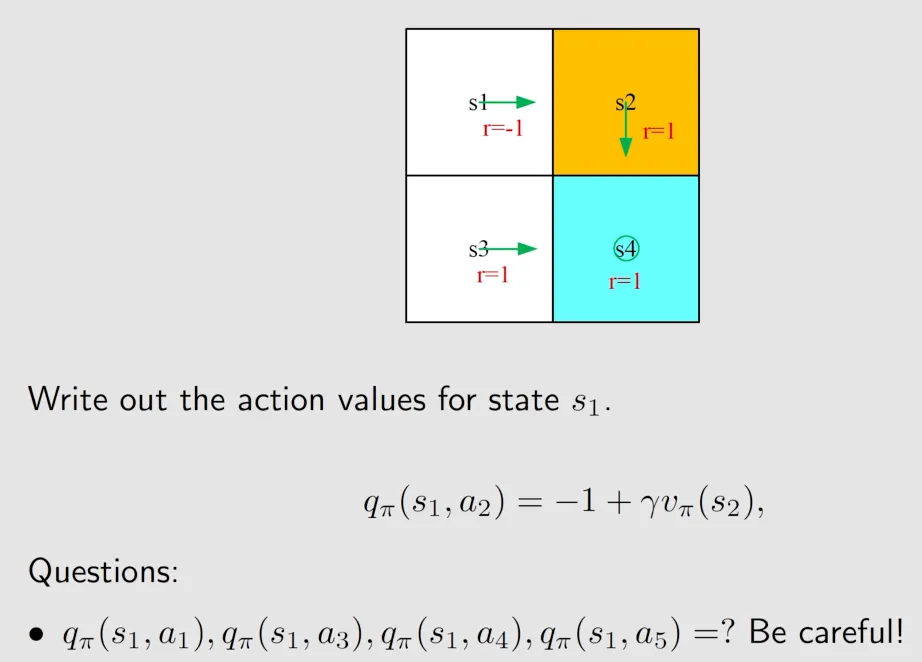
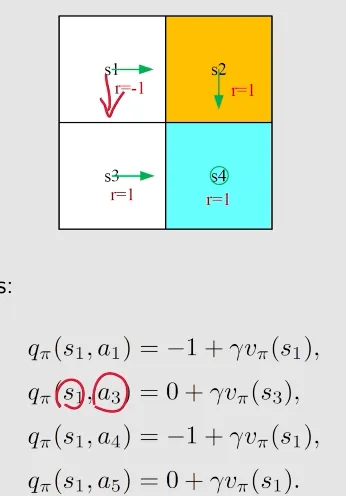
接下来要更深地理解一下action value