Lecture 4: Value Iteration and Policy Iteration Algorithm
强化学习中的数学原理 | 第四课

本课程中第一次正式介绍强化学习算法,且是一个model-based算法
很重要
下节课将介绍model-free的算法
先回顾一下
- How to solve the Bellman optimality equation?
- In the last lecture, we know that the contraction mapping theorem suggest an iterative algorithm:
where
- this algorithm is called
value iteration
The algorithm
can be decomposed to two steps.
- Step 1: policy update. This step is to solve
where
- Step 2: value update
注意这里的
接下来,我们要学习 elementwise form 来使用这个 algorithm
- Matrix-vector form is useful for theoretical analysis
- Elementwise form is useful for implementation
- Step 1: Policy update
The elementwise form of
is
the optimal policy solving the above optimization problem is
where
- Step 2: Value update
The elementwise form of
is
Since
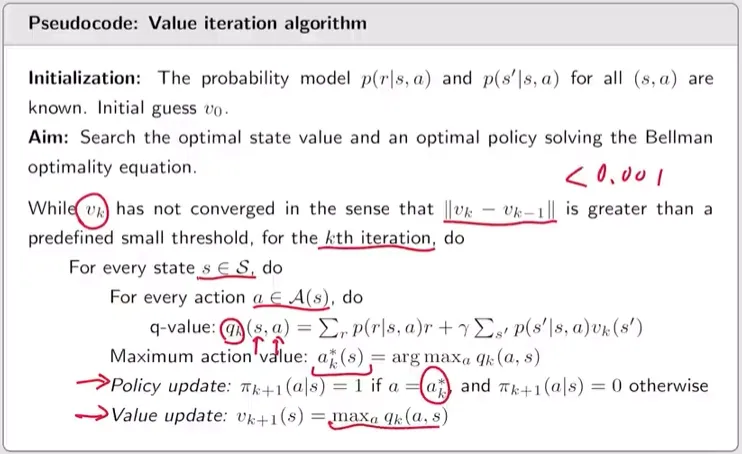
- 当
还没收敛的时候: - 遍历每一个状态空间的
: - 遍历这个状态下所有的
(不只是策略里有的action): - 算出 q-value:
- 算出 q-value:
- 找到哪一个
对应的是最大的 : - 把找到的
的概率在策略中更新为 1 - 把这个
的state value更新成这个 的action value
- 遍历这个状态下所有的
- 遍历每一个状态空间的
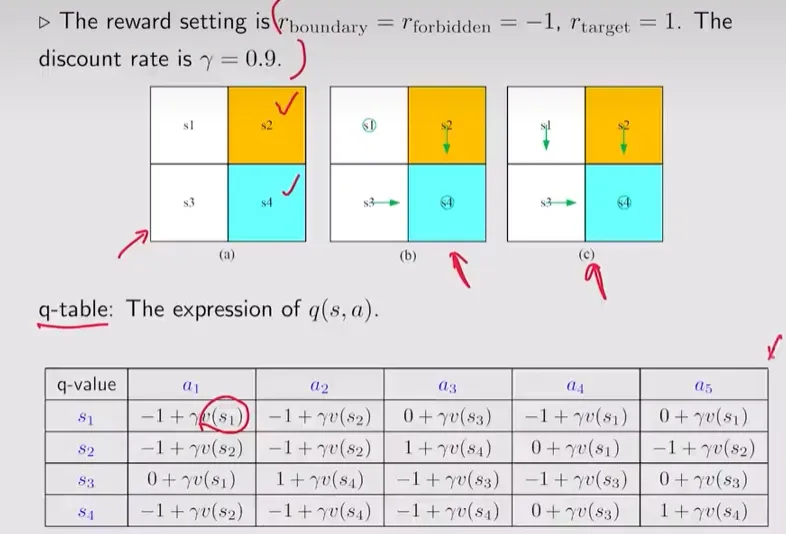
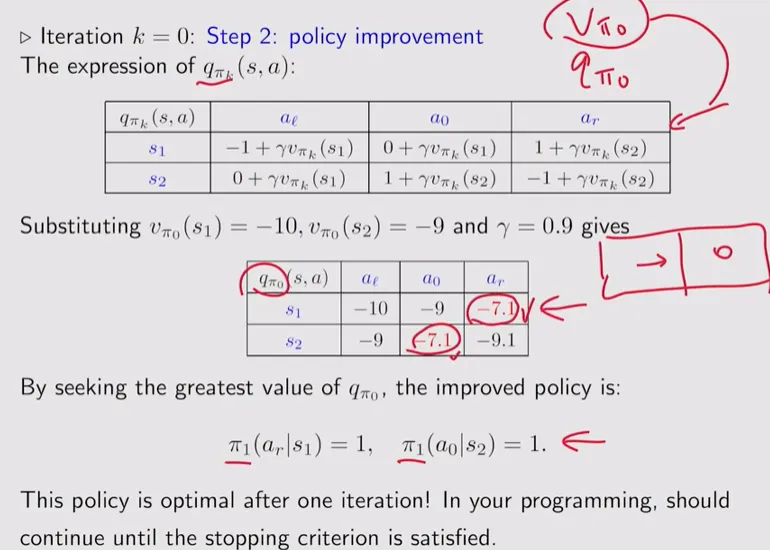
看到下面这个表格,要理解意思是,我们得到
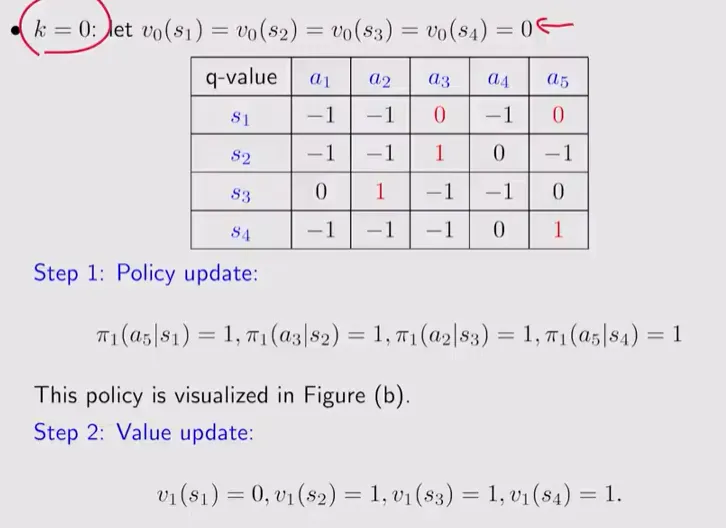
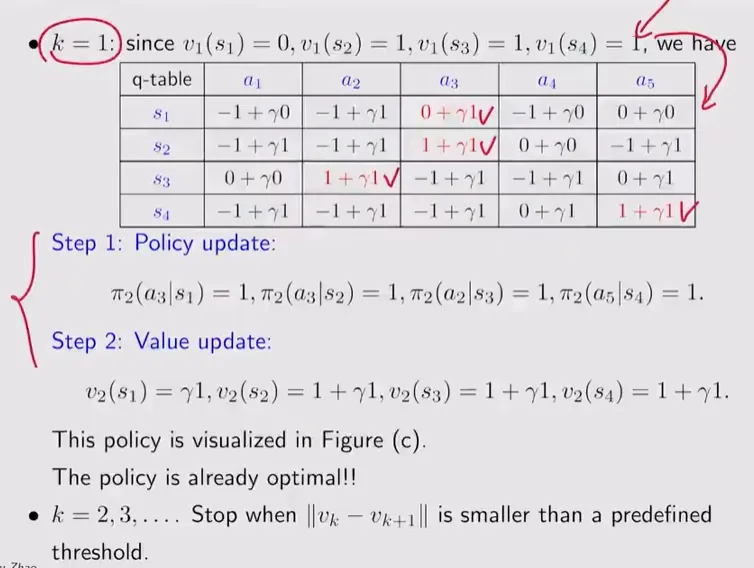
Given a random initial policy
- Step 1: policy evaluation(PE)
This step is to calculate the state value of
Note that
- Step 2: policy improvement (PI)
The maximization is componentwise!
The algorithm leads to a sequence
PE = policy evaluation, PI = policy improvement
- policy evaluation中,如何求解state value
在贝尔曼公式中已经详细介绍过了
- Closed-form solution:
- Iterative solution:
- Policy iteration is an iterative algorithm with another iterative algorithm embedded in the policy evaluation step. Policy evaluation 是 policy iteration 这个算法的一步,而这一步又依赖于一个迭代的算法
- policy improvement中,为什么新的policy
比 好
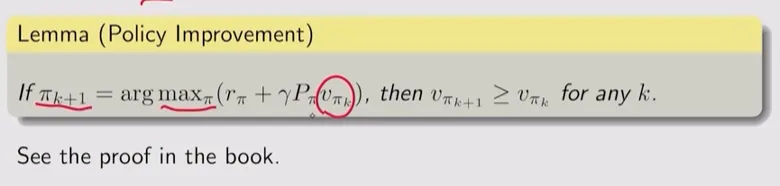
- 为什么这个迭代算法最后得到的是最优 policy
- 这个 policy iteration algorithm 和前面讲的 value iteration algorithm 什么关系?我这个很想知道这个
后面会详细讲,policy iteration 和 value iteration 实际上是 truncated policy iteration 算法的两个极端
Step 1: Policy evaluation
- Matrix-vector form:
- Elementwise form:
当
Step 2: Policy improvement
上一步我们找到了
- Matrix-vector form:
- Elementwise form
Here,
Then, the greedy policy is
我是真的讲不清和value iteration的区别在哪里,如果我看懂了会在后面再写的
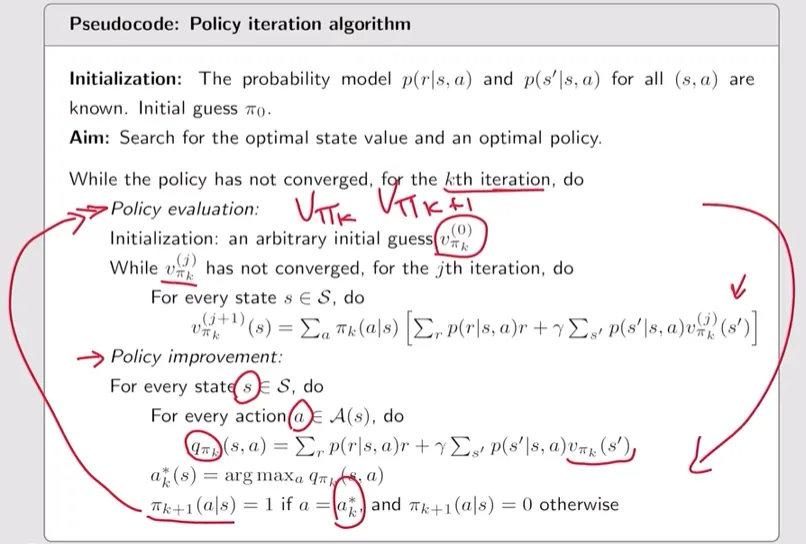
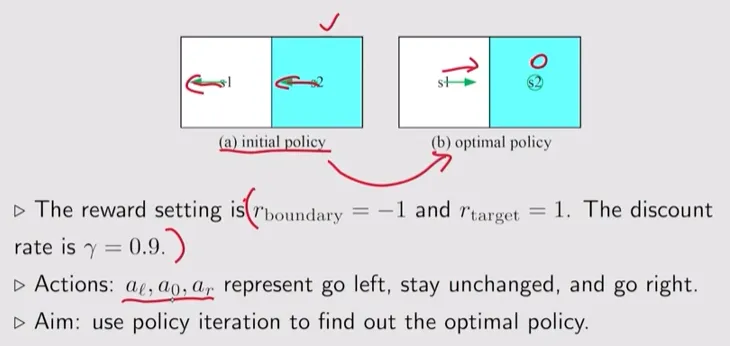
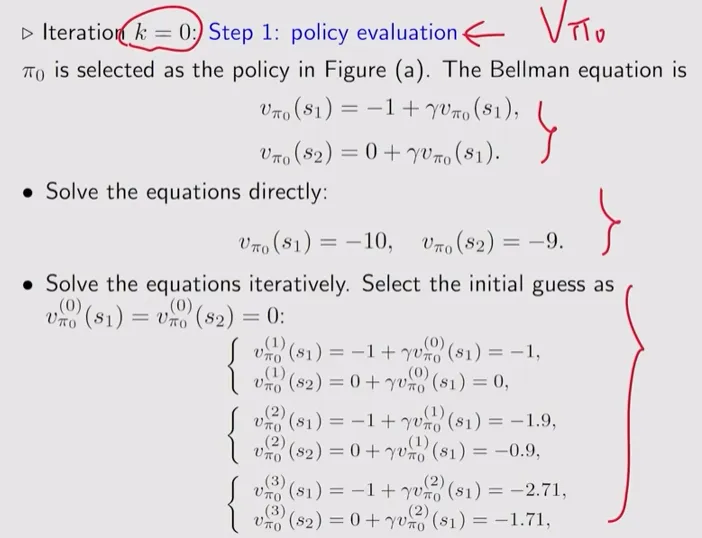
看这步感觉有点知道迭代是何意味了,其实就是一种解法,你也可以直接算
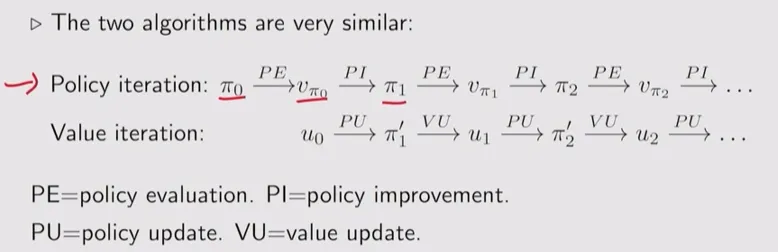
应该是一个能把上面两个algorithm统一起来的一般化的推广
- Policy evaluation (PE):
- Policy improvement (PI):
- Policy update (PU):
- Value update (VU):
这两个算法是非常类似的,但tmd区别到底是什么,要把关键点出来
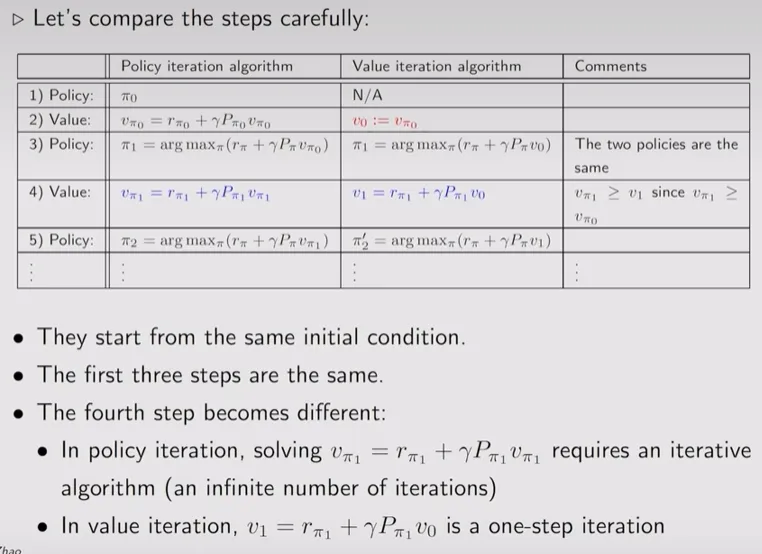
关注第4步,这里是两个算法差异所在
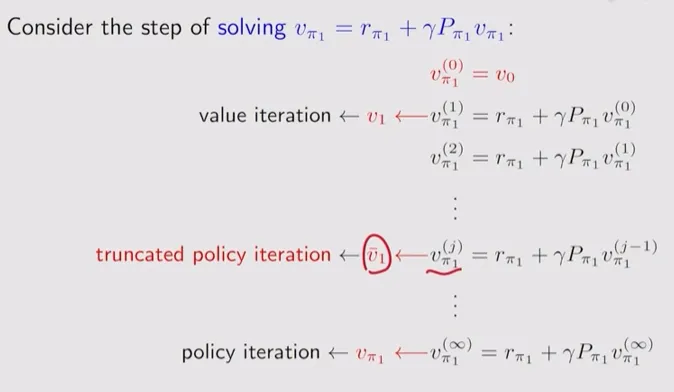
妈的,绝了,关键在于更新策略的频率
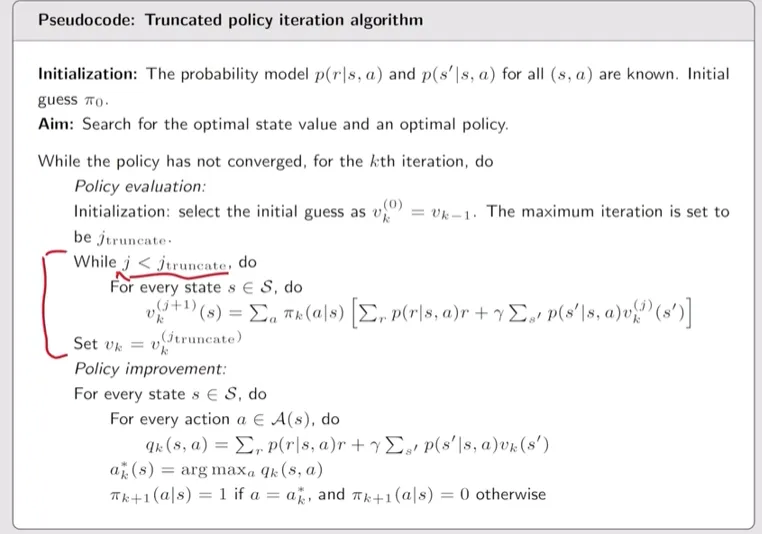
和policy iteration algorithm框架完全一样,就是迭代次数有截断而不是等到收敛了再截断
之后会关心
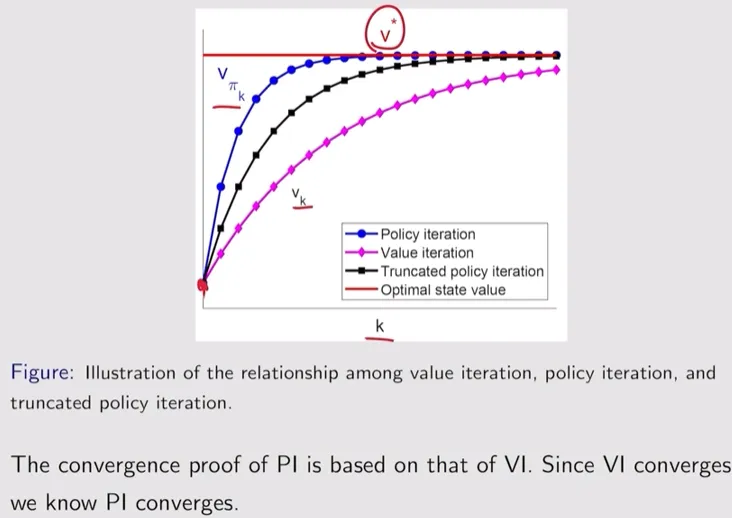
三种算法收敛速度的比较